

A Night Out in Newcastle
I took a festive trip into Newcastle's nightlife after years and years away

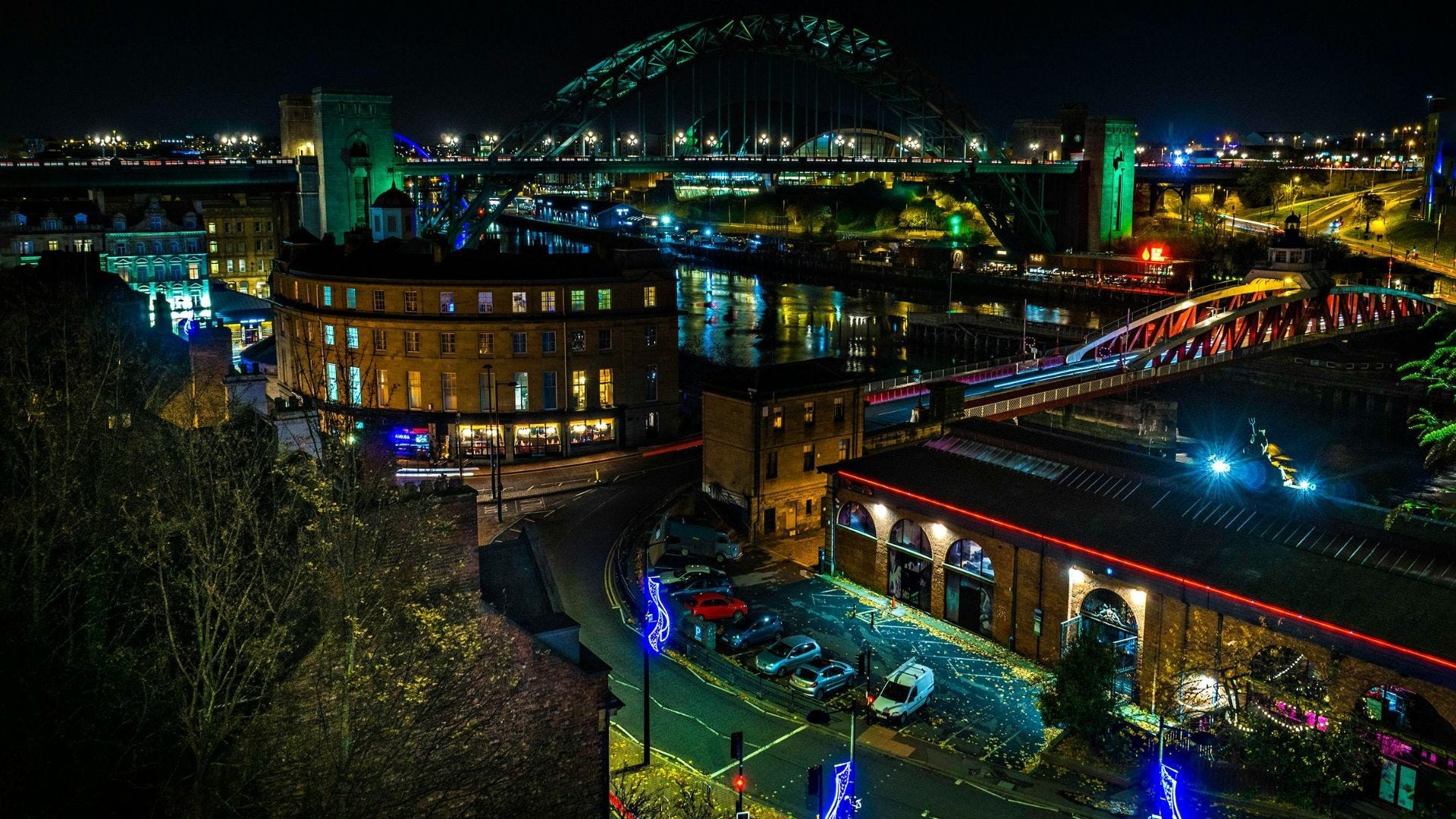
This Christmas, I finally relented after years of pressure and agreed to go out for a night on the drink in Newcastle with an old friend, Alex. I stipulated that we stay away from the Bigg Market and linger around the Haymarket, which is more suitable for our age group, and the deal was done.
As the day approached, I began to ponder the chances of me becoming a viral video on X depicting an immigrant stabbing me to death. This is a sort of morbidly meta view of social media dynamics and virality, in which there’s an iPhone, CCTV footage, clickbait, and 12 hours of rage awaiting every one of us.
Still, exaggerated as it may seem to envision one’s untimely death at the hands of an immigrant and becoming viral content in the process, it does speak to the general aura lingering over perceptions of English cities. It’s a perception that certainly wasn’t there back in our glory days of hitting The Toon.
I took the bus from Blyth to Newcastle around 5.00 pm, just in time for the evening rush. The buses exemplify the hyper-regulated aesthetic common in third spaces these days, which has scraped out all frivolity and humanity, leaving only a purely functional vehicle. Long gone now are the woollen tartan designs on the seats, often with an ashtray on the back.
Instead, we have a heavy grey rubber substance, presumably complying with some health and safety diktat. The spaces allocated to the disabled seem to encompass half the seats on the bus, and the décor is a series of woke corporate ads and myriad handles and railings, also grey, to ensure that slipping or falling is an impossibility.
Halfway to Newcastle, in Benton, the bus begins to fill up with Indians, presumably working in the recently built “Business Park” nearby. A utilitarian workforce boards utilitarian public transport, while outside in the gloom, LED street lights create a permanent liminal landscape.
Regardless of the passengers’ ethnicity, everyone stares at their devices until we reach Newcastle.
The Haymarket bus station seems colder and shabbier than I remember. There are more foreign faces, and a single homeless man is white. The foreigners are waiting for buses to take them to relatively obscure corners of the North East like Dinnington and Seaton Burn, which still startles me after all these years.
I cross the road to Percy Street and make my way toward the Three Bulls Heads, where I will be meeting Alex.
There’s a large and seemingly plush and swanky Chinese restaurant on the way, as well as bizarrely, a large Somali barbershop. I make a mental note of the barbershop for conversation later in the evening. Percy Street is prime real estate in Newcastle. I find the idea that a Somali immigrant can establish a business cutting hair between such local landmarks as the Three Bulls Heads and the Hotspur to be ludicrous. Besides, everyone is suspicious of all these barber shops popping up everywhere like mushrooms.
Not much has changed at the Three Bulls; the décor is a bit brighter than it once was, and their beer selection has been (thankfully) expanded. I glance over to the corner on the right, beside the disabled toilets. It was there, in the late ‘90s, that 8 or 10 of us would gather every Saturday afternoon. It was there that I watched rolling news coverage of the death of Diana, Princess of Wales, and the fallout. I remember the faces present, the packets of Lambert & Butler cigs on the table, the horribly crude banter that seemed funny, the arguments and gossip, the vitality. All in that corner.
My friend Alex arrives shortly after, and I point over to the corner. He, too, remembers it and jokes about the abuse the disabled toilets got. Still, though, where once there were ten of us, there are now just two.
Despite my personal recollections, neither Newcastle nor its pubs are mere dusty relics of bygone days; on the evening in question, it’s rowdy, and there’s a football match on, Newcastle vs Aston Villa. I have no interest in the football, and never did, and that too gets rolled into the conversation.
Upstairs in the Three Bulls, I notice an attractive barmaid who is a perfect rendition of the archetype of the Geordie barmaid. Long brown hair, pulled into a ponytail, dressed all in black, terse school teacher mannerisms, an attempt to downplay her accent, which doesn’t quite work, the features of the actress Anna Friel. Again, things may change, but others remain the same.
We settle in to drink rounds of an IPA called “Neck oil”, which is a bit too fruity but goes down well.
Unsurprisingly, the conversation turns to politics, particularly immigration. Alex has two young daughters, and the relentless churn of migrant-related sex crimes against English females is turning his hair grey and keeping him awake at night. This sentiment is everywhere, as I’ve noted in other writings and broadcasts. All of my family shares it, and everyone they talk to does. Where is all this heading? What will it be like when X becomes a teenager? Has the government become demented?
What, for example, are the processes that led to a bus in Benton filling up with Indians? Or, for that matter, the ability of a Somali to open a barbershop on Percy Street right alongside some of Newcastle’s most iconic pubs? How does all this work?
Ten years ago, I was regarded as hysterical, and my diatribes were met with rolling eyes and sarcastic yawns, but not any more. Now I find myself the centrist, the cooler head.
The framing of these discussions is in and of itself interesting because family and friends will concede that “Newcastle is not as bad yet as…” but implicit within such a statement is that mass immigration is inherently harmful.
Over the course of the Christmas season, my father had railed that English football fans would be violently antagonistic against each other over a stupid sport, but were seemingly blind to something such as the grooming gangs. It is a common criticism of Englishmen, and looking around the bar and hearing the yells and swearing at the football, it is tough to refute or not take seriously.
We venture to the next bar down, formerly the Goose & Garden, now called The Magpie. It’s an expansive space like a barn, and men in their 40s and 50s yell and jeer at the multitudinous flatscreens showing the game. Curiously, there’s a younger generation in the mix who pay no attention to the football because they’re engrossed in their own screens. Neither are the Zoomers wearing Newcastle FC regalia; instead, they wear the baggy, androgynous uniform they seem to wear all the time.
Looking at the scant presence of anyone under 25 and the heavy (literally) presence of men in their 40s and 50s makes me realize that the same people are propping up Newcastle’s pub scene in the 2020s as were doing so in 1997, which is to say, my generation.
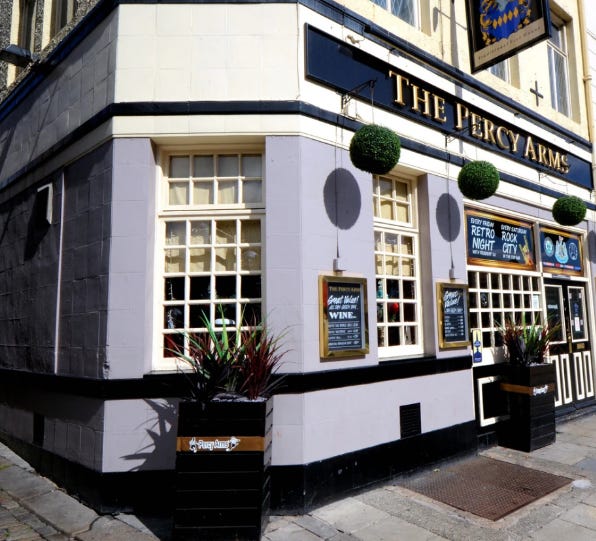
Six pints down, and we loop back up toward Haymarket and enter the Percy Arms. Colloquially called “The Percy”, the old pub is far smaller and more intimate than what we’ve seen so far. Long sofas along the walls, people sitting at the bar, and groups all within earshot of one another cram into what is an excellent example of an old-fashioned English pub.
Newcastle always had an array of obscure backstreet pubs frequented by the working class coming in from the West End and areas such as Cowgate. I had wrongly assumed that such pubs, along with their customers, would never have survived the changes of the previous decades, yet they were thriving in the Percy, as if preserved in amber set in 1999.
If I were to do the night over again, I’d have spent the whole evening in the Percy, but 7-8 pints down, I was beginning to reach what I can take these days, so we decided to get a greasy pizza for old time’s sake.
Walking through Haymarket bus station once again, I noted that the number of homeless people preparing to spend the night in borderline freezing temperatures had now swelled to four.
All of them were white British natives.
Thus, it is impossible to ignore the grim realities and twisted juxtapositions inherent in British life. You can try and push it out of mind all you want, but there remains that little bell tinkling away, demanding that you mention something about migrant hotels and HMOs (Houses of Multiple Occupancy). Are the same processes at play that led to a Somali having a barbershop on Percy Street? Or the Indians boarding the bus in Benton?
Of course, I can and often do speak at great length about managerialism, the institutionalised anti-whiteness, the rotting incentive structures, and general trends within the culture and politics that create such outcomes. But the point is, this is normie street, this is me and everyone in the real world witnessing it with our eyes. You do not need to be schooled in the dark arts of online right literature to understand the injustice and sheer brutality of the current system.
The pizza shop was owned by some stripe of Europeans from the south-east, such as Bulgarians or Macedonians, or perhaps Turks or Kurds; it’s hard to tell. The place was dominated by a leathery-faced patriarch who looked like an older Leonard Cohen, and the food was a bland but spicy slop. The exterior was a gaudy display of yellow neon lighting, and a constant churn of activity bustled around the place - taxis, foreigners wandering and shouting something, then wandering out, and takeaway drivers picking up orders.
It was a network of sorts whose real activities I could only imagine, though in fairness, I did not intuitively get the worst gut feeling I’ve ever had. Still, though, our people were sleeping in the cold in a bus station while these people were thriving.
After we left the pizza shop, Alex made for the bus, and I had twenty minutes to kill, so I went for a final quiet pint at a bar on the corner of Haymarket called The Junction, though it used to be called Old Orleans. Unusually for me, I’m hit with a genuine wave of nostalgia for the first time. I came here many years ago on a date; a barmaid I’d pestered for weeks finally relented, and we agreed to meet at the Old Orleans. She turned up wearing sluttish see-through lace pants. She, too, was that archetype of the Geordie barmaid.
Feeling tired, drunk, and mildly sick from the pizza, I ruminated over my night back out in Newcastle. I didn’t get stabbed, at least. In fact, it didn’t seem to be very dangerous or even very lively at all. It was both reassuringly familiar and yet strangely cold, oddly hollowed out or exhausted, in an intangible way. Not in the drastic, shattering manner in which other parts of the country have shifted in terms of identity.
When I went on the date in Old Orleans, it seemed richly designed and high status; it was certainly expensive. Yet now it seemed worn out and shabby, I wasn’t sure whether it was just me or the old town.
In truth, I think it is probably both.
Apparently, they were playing Burnley, not Aston Villa.
They can’t make a pizza, spicy slop is a perfect description. It’s hard to understand how something can be over spiced and bland at the same time but they manage it.