



The Reform Party’s Richard Tice was recently asked by GB News journalist Steven Edginton whether or not he was concerned with the white British becoming a minority in a few decades. The question came off the back of Matt Goodwin’s work on demographics that projected the date to be 2063. Tice reacted to Edginton’s question with a mixture of awkwardness, evasiveness, and derision, finally quipping, “I’ll be long gone by then”. He also claimed that Edginton was “obsessed with this stuff” presumably thinking of a previous Edginton interview with Nigel Farage. Farage was similarly dismissive of Edginton’s questioning and, like Tice, earned the ire of the online right.
People tend to quibble too much about the minutiae of the white British tipping over into minority status. Perhaps it could be as early as 2030 in schools, 2045 for people under 30, and possibly 2050 for the general population.

The primary issue is not the date but the trajectory of demographic change, and recently, that trajectory has had an unusual degree of attention in the British press.
The problem for people like Richard Tice and Nigel Farage (they are by no means alone) is that they face a binary, and whatever answer they offer will offend or alienate many people. Moreover, the discourse on demographics and the prospect of the British natives being reduced to a minority in Britain is hurtling toward the mainstream, whether or not the correct framing and argumentation surrounding it is understood.
The question, fundamentally, is: Should the white British be prevented from being reduced to a minority?
I use the term “white British” because that, and not “indigenous” or “native”, is how it stands on the census, which, ultimately, is the source of the whole discourse. Nigel Farage is not entirely new to the discussion on demographics. In 2022, he posted a video to X in which he expressed alarm at white British people becoming a minority in various cities across the country.
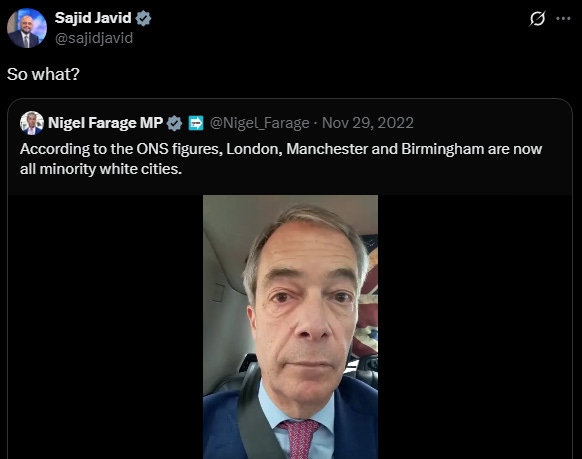
As we can see, Conservative Party MP Savid Javid demanded to know why it matters. Oddly, this is essentially the position Farage himself has adopted since. Yet, Javid has posed an interesting question to Farage which, in my view, he can’t actually answer in full. My own answer would be that it was a result of the greatest betrayal in our history, and that the long-term effects of it will be catastrophic for our people. I would define the white British not as a statistic but as the native inhabitants, and I would define native inhabitants as being those people who are here organically and not as a result of bureaucratic processes — unlike Savid Javid, who is.
Both Farage and Javid hold to a civic definition of what constitutes a people, which is to say, one rooted entirely in bureaucratic procedures. Within the context of such thinking, Javid has a point. Why exactly was Farage concerned when, presumably, the vast majority of people in the cities he mentioned have their passports and paperwork in good standing with the Home Office?
I feel as if I should point out here that, for once, I’m not launching an attack on Farage but instead using him as an avatar of a mindset within the British right that, in my opinion, is redundant.
The civic, or procedural approach to demographics would be to argue that “integration” becomes untenable when the numbers are so massive. Yet, this merely begs the question of what integration means — what values and principles does one need, and who or what are they intrinsic to?
The political centre has for decades been able to use an endless and tedious discourse around integration and values as a comfort blanket to foot-drag and obfuscate in the face of changing demographics. People further right in the Nationalist scene have long used dates as doomsday deadlines that herald a disaster of unprecedented scale.
The problem posed by the question of the white British being reduced to a minority is that it is not rooted in values, but in ethnicity and tribalism. There is no Goldilocks zone of Quango-generated talking points about it being British; there are just two paths: either we become a minority or we do not.
If a political party such as Reform UK were to concede that the natives should not become a minority, then logically it follows that policies would have to be drafted to prevent that outcome. And this is the problem. People such as Richard Tice and Nigel Farage know that if they were to concede that it should be stopped, they would have to explain how that would be achieved. Preventing the white British from becoming a minority would spell the dissolution of their civic understanding of peoplehood and lead to ethnicisation, which is to say, race-based advocacy.
It goes without saying that a political party that is explicitly rooted in the racial interests of the white British would face harsher scrutiny and be less well-received by the mainstream, to the degree that it may very well be illegal. Or rather, policies of mass deportations or prioritising one group above others would be extraordinarily radical from the perspective of Hampstead dinner parties, and perhaps even the general population itself. Thus, it can be argued that a degree of Machiavellian pragmatism is needed to become effective. Yet such pragmatism, if it exists, would be publicly disowned the instant it was questioned, and the people opposed to becoming to a minority would once again find themselves without representation.
Professor David Betz has stated that, as the demographic noose begins to tighten, so too will resistance to further demographic change as a form of “fight or flight” kicks in among the population.
The other scenario, of course, is that the discourse surrounding demographic change remains “locked” in the sense that those opposed will be brushed aside, exactly as Farage and Tice brushed aside Steven Edginton. Notably, such a response was more easily digested by the public in, say, 2002, when the claim seemed outlandish and paranoid. In 2025, with the natives already minorities in many cities and towns, and more importantly, seeing and feeling the difference on their streets, waving away the doomsday date seems weak and perhaps even treacherous.
Again, either it is to be accepted that the white British, as they stand on the census, become a minority in their only homeland, or they do not. The political class as a whole will, in the coming years, have to confront this epochal change regardless of what they think about it. To enact policies now in order to prevent it would inevitably be regarded as racist, the gravest of sins. Yet, despite what we’ve been told our entire lives, the liberal mainstream assumes that race won’t matter when white people are in the minority — without a shred of evidence, of course.
When discussing the shifting demographics in the West, it is crucial to understand and emphasise that it is not how Europeans view others that matters; rather, it is how they themselves are viewed that matters. Let us take, for example, the Equality Act that legislates in favour of “protected characteristics” of “vulnerable groups”, essentially allotting special favours to the State’s client groups. The assumptions baked into the legislation are of a society constituted upon a white majority as the norm. Yet, as that majority becomes a minority, will the legislation be repealed or amended? If so, then what does that conversation look like, and who or what would be responsible for it?
The fact is, it won’t happen because it would be absurd to give every spectrum in society a protected identity classification. There will be no legalistic protections for the white British as a minority, and if there were, it would be entirely dependent on the empathy and ideals of other groups.
The Equality Act, as well as mountains of other legislation, laws and protocols, reveal an uncomfortable truth about the multicultural society: it isn’t actually race-blind as it stands now, and it never has been in the past. Neither will it be in the future.
Race-thinking is thus an inevitability. The question then returns to the discourse surrounding the swiftly changing demographic situation in the UK, and the question must be addressed now, with all of its awkwardness and potential minefields, or it will take place later, when the situation and any remedies become even more draconian or unfeasible.
We currently find ourselves in an unstable holding pen, or containment, if you will. The incentives of the system all point away from discussing the most seismic population change ever seen on these islands. Yet, despite the news cycle offering daily distractions and juicier intellectual morsels to mull over, ultimately, it is all that matters.
I am something of an absolutist on the issue in the sense that, without a secure place to call home, a people is just flotsam being tossed around on the tides of history. Having a home transcends economic systems, material needs, intellectual abstractions, and universalist ideals.
It is, in the end, all that matters.
“I’ll be long gone by then” is probably both all-too common and the most character-revealing answer of all possible answers.
They only care about that question when it’s about Israel.